MailGuard has intercepted a new email campaign impersonating Telstra that attempts to lure recipients into completing a fake customer survey before directing them to purchase a heavily discounted WiFi booster device.
It uses deceptive branding, false urgency, and misleading claims to drive recipients through a sophisticated sales funnel.
The scam demonstrates how cybercriminals and online fraudsters continue to exploit trusted brands to manipulate user behaviour and profit from unsuspecting recipients.
What the Email Looks Like
The email arrives claiming to be from "Telstra_Team" and promotes what appears to be an exclusive loyalty reward for long-term Telstra customers.
Recipients are told that a limited number of discount codes have been reserved exclusively for loyal customers and that they can receive a Telstra WiFi Booster at a 65% discount.
The email uses language designed to create exclusivity and urgency, including claims such as:
- "It was never made public."
- "Only 139 codes remain."
- "Yours expires at midnight tonight."
- "Claim My 65% Discount"
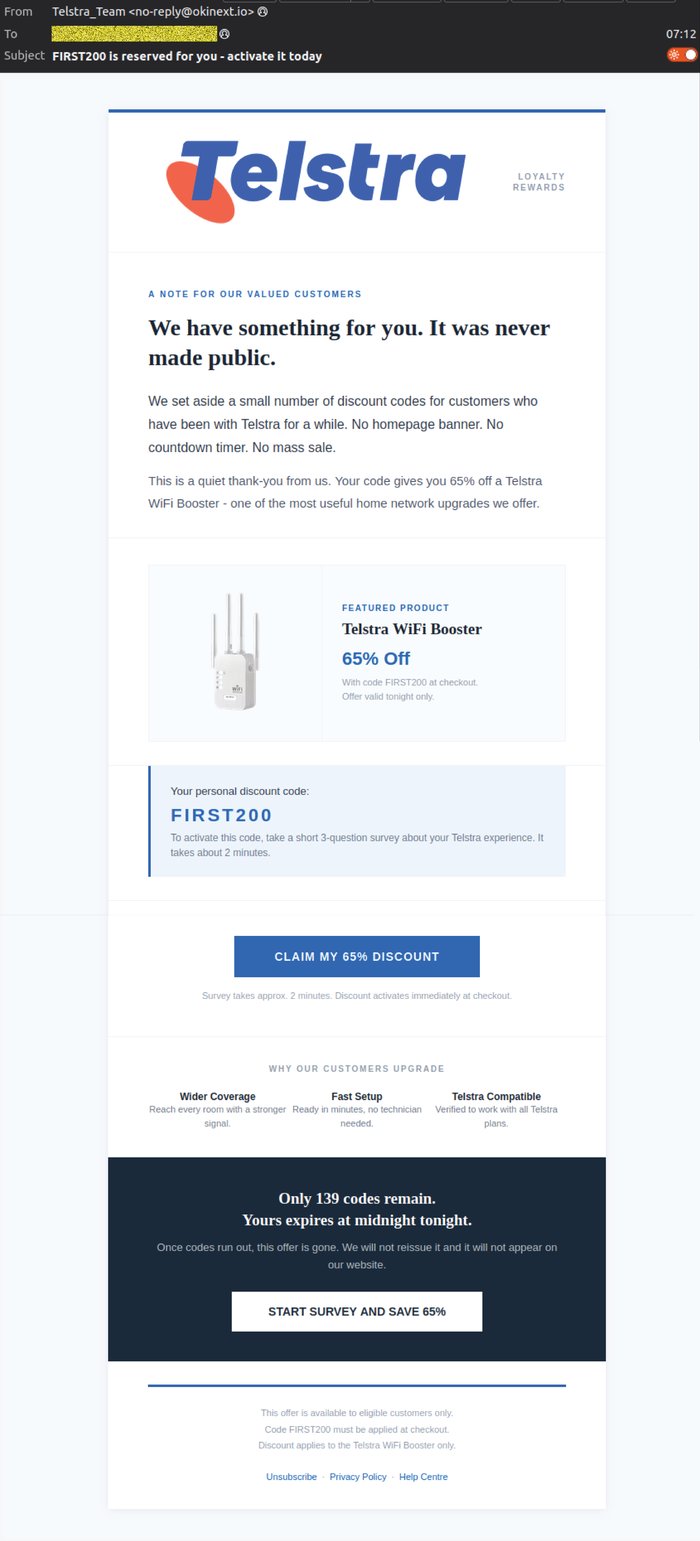 Example phishing content shown using Telstra branding. Not affiliated with Telstra.
At first glance, the email appears professionally designed and prominently features Telstra branding.
However, closer inspection reveals several warning signs.
Most notably, the email does not originate from Telstra. In examples observed by MailGuard, the display name is "Telstra_Team" while the sender address uses unrelated domains and Amazon SES infrastructure. The mismatch between the trusted brand and the actual sending domain is a significant indicator that the message is not legitimate.
The Fake Survey Funnel
Unlike many phishing campaigns that immediately direct users to a credential harvesting page, this scam takes a more gradual approach.
Recipients who click the email are taken to a landing page featuring Telstra branding and a supposed customer survey.
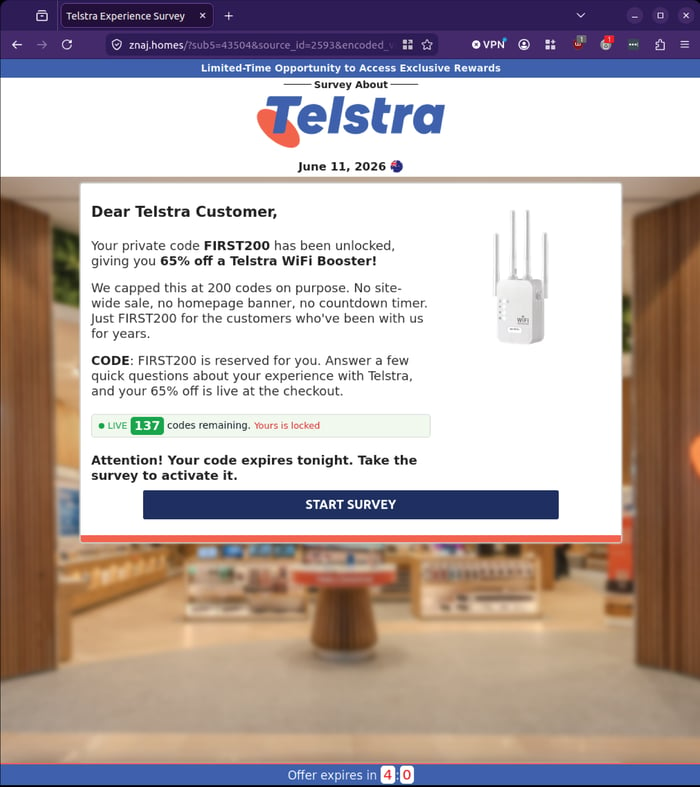 Example phishing content shown using Telstra branding. Not affiliated with Telstra.
The page claims the user has unlocked a private discount code called FIRST200 and must answer several questions to activate the offer.
The survey itself consists of a series of simple questions about home internet usage, WiFi performance, streaming experiences, and connectivity frustrations.
Examples shown below, include:
- Where do you mostly see Telstra advertisements?
- What Telstra service do you use most?
- Do you experience weak WiFi spots at home?
- What is your biggest WiFi frustration?
-
Would stronger WiFi reduce daily frustration?
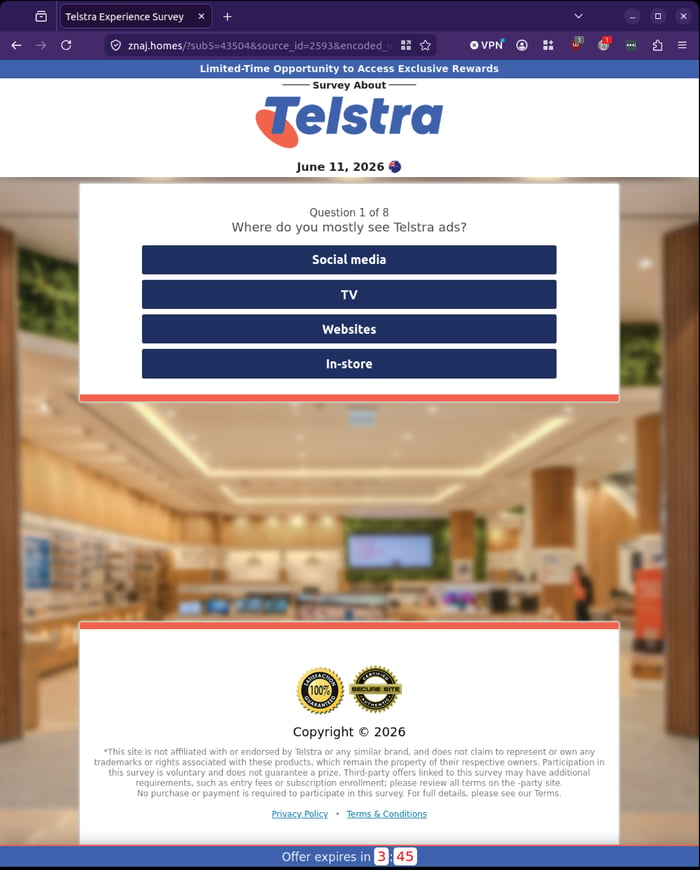
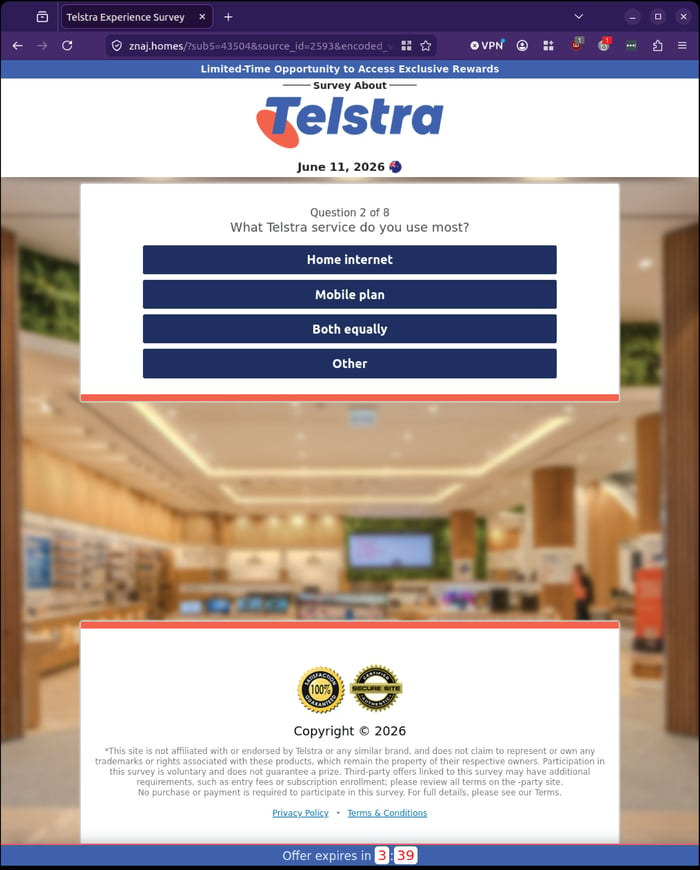
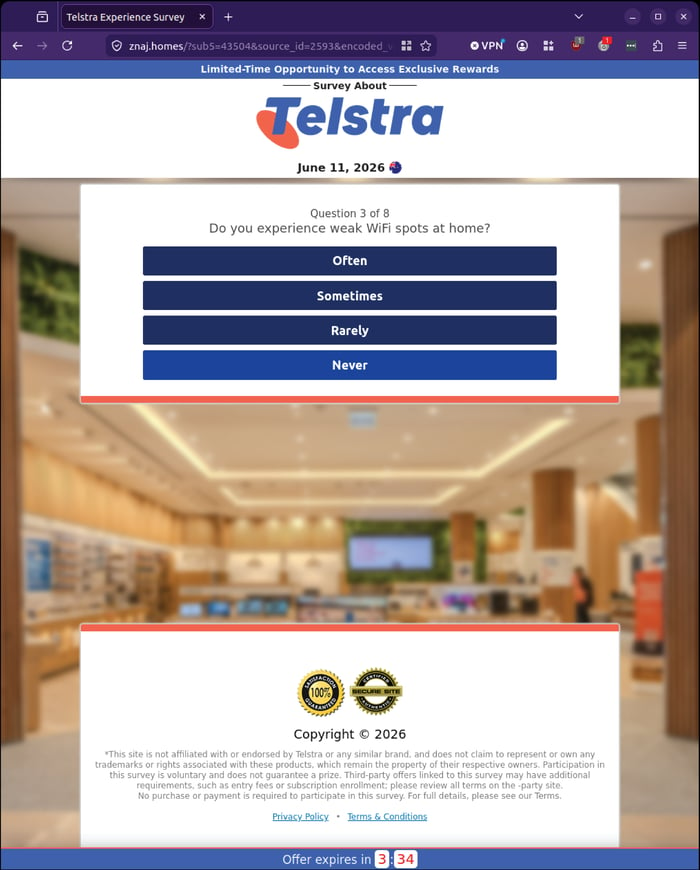
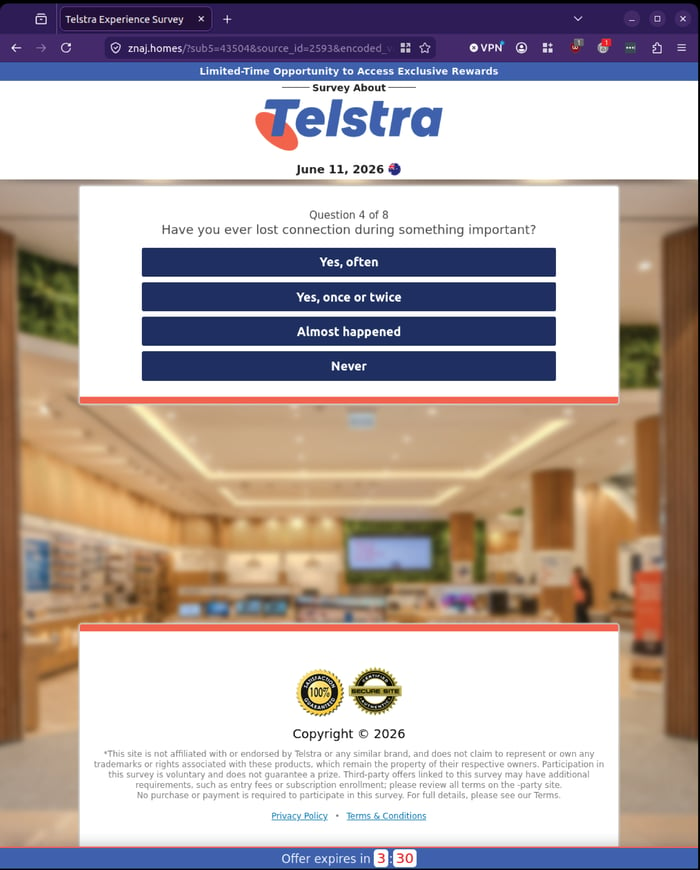
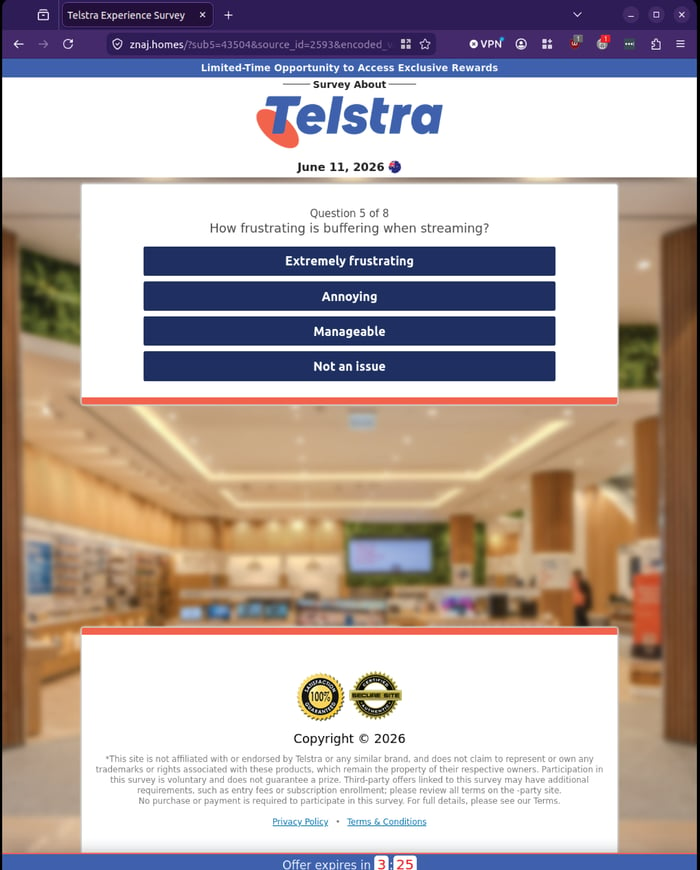
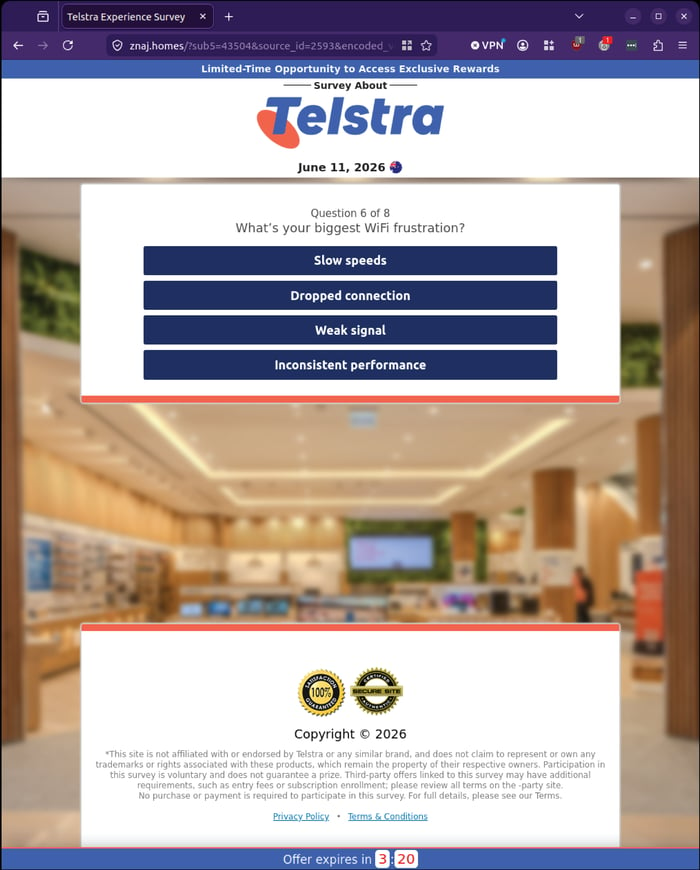
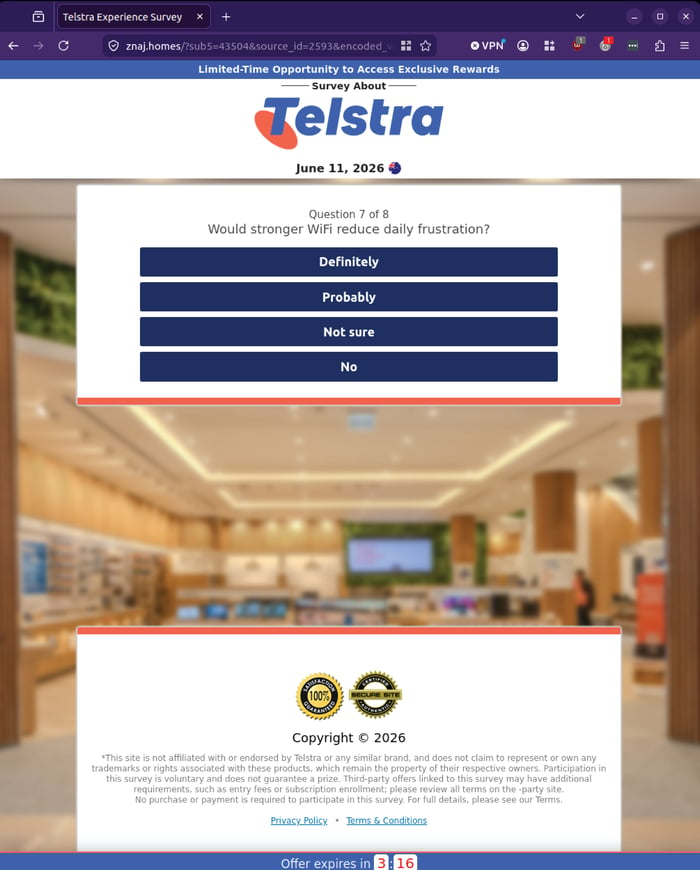
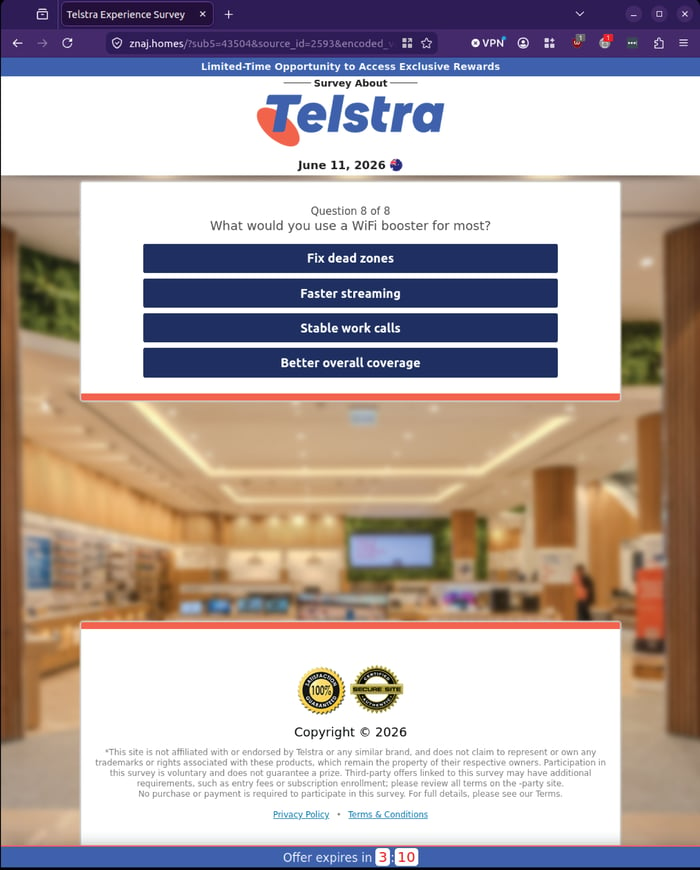
Example phishing content shown using Telstra branding. Not affiliated with Telstra.
The questions are generic and appear designed primarily to keep users engaged rather than collect meaningful customer feedback. Throughout the process, countdown timers and scarcity messaging are displayed to create pressure and encourage completion.
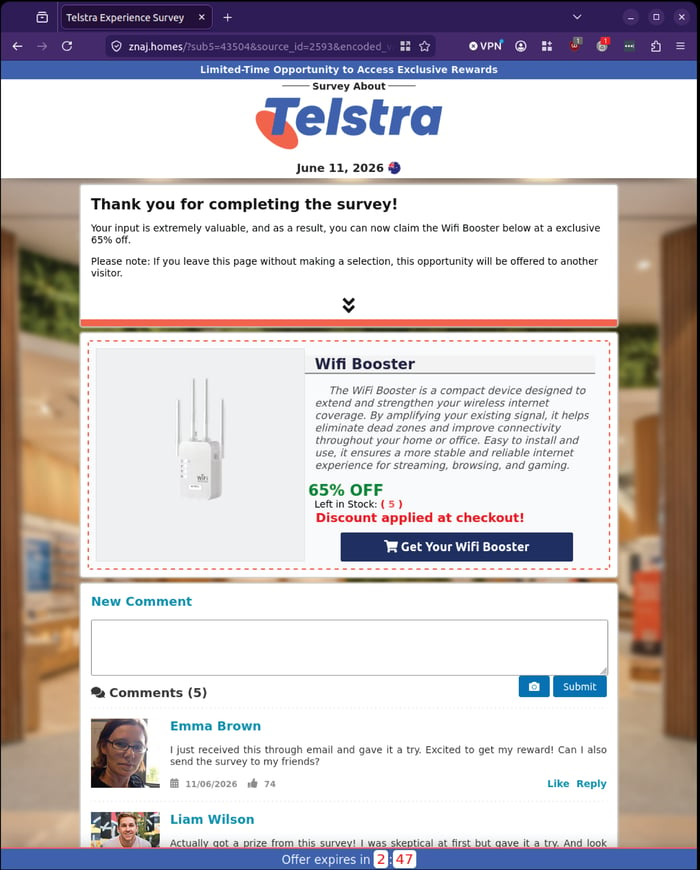
Example phishing content shown using Telstra branding. Not affiliated with Telstra.
The Final Sales Pitch
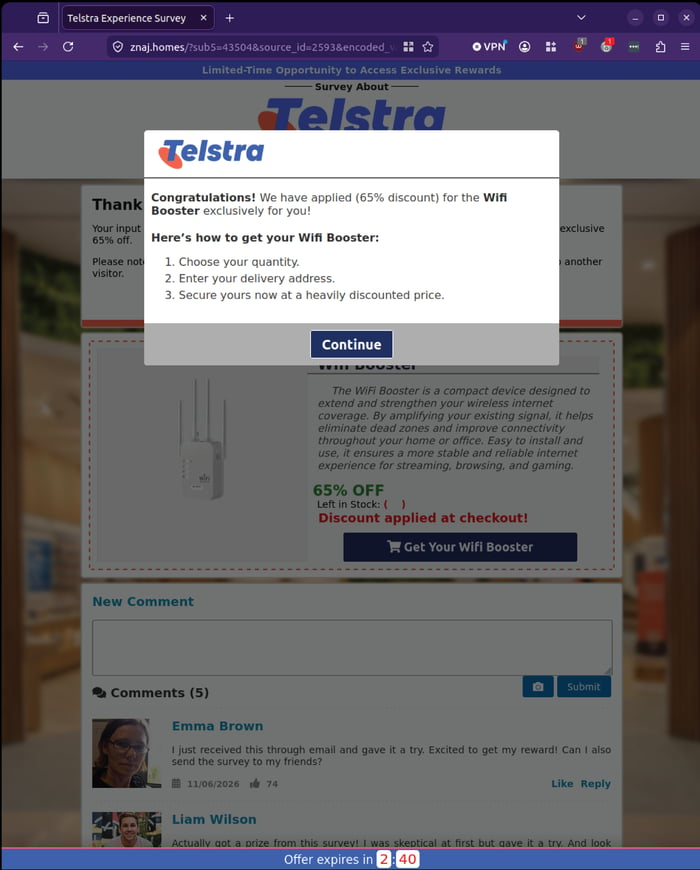
After completing the survey, recipients are congratulated and informed that they have qualified for an exclusive 65% discount on a WiFi Booster device.
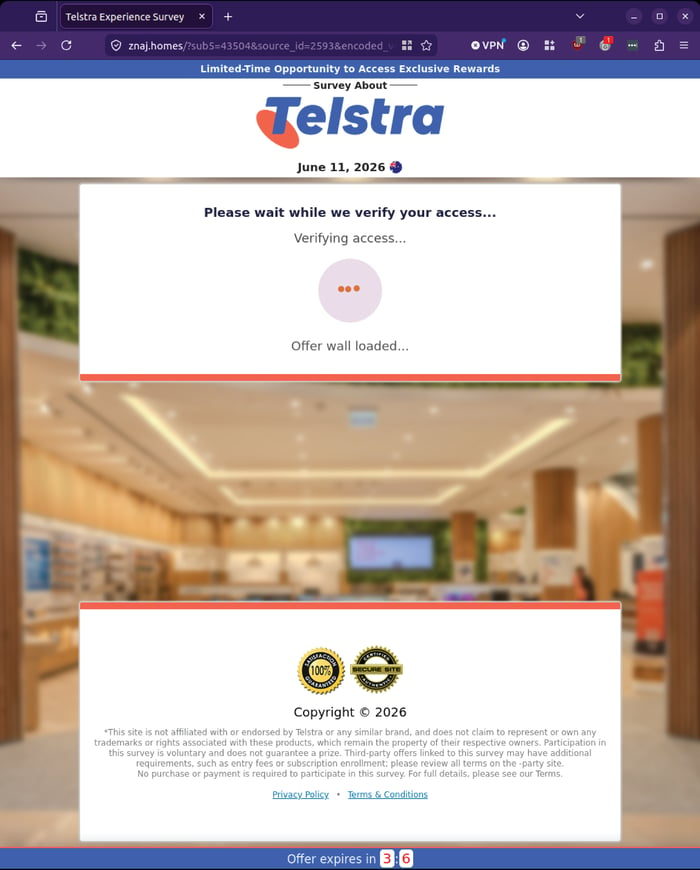
Example phishing content shown using Telstra branding. Not affiliated with Telstra.
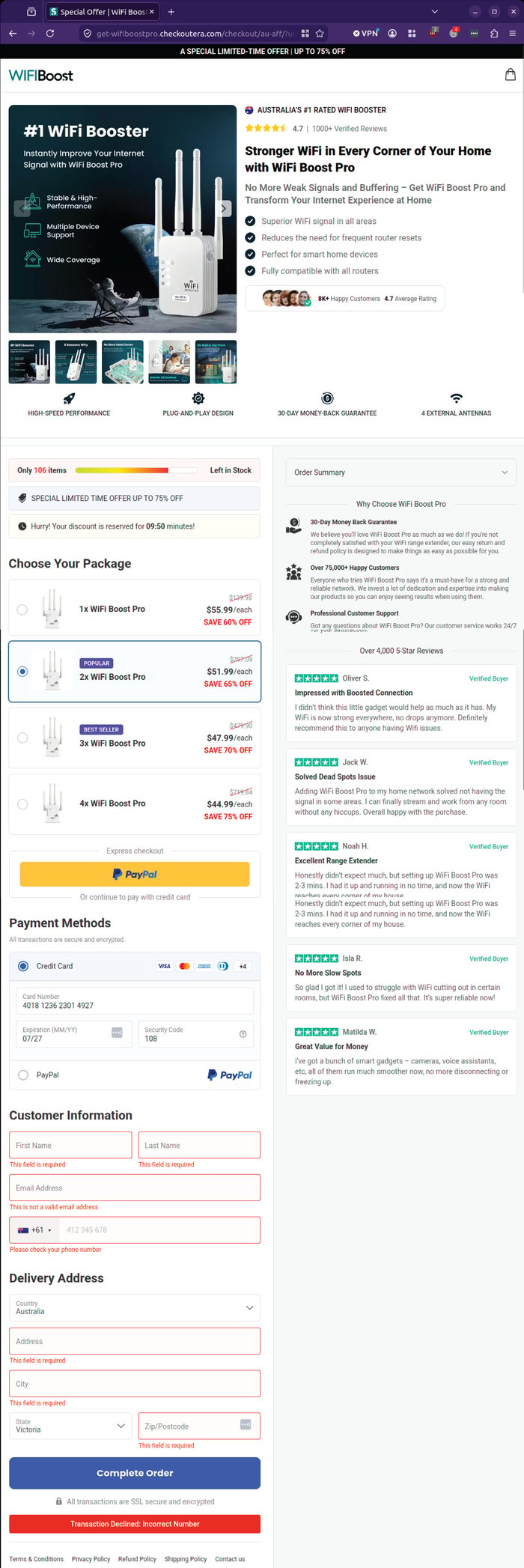
The campaign then transitions users to a separate e-commerce website promoting a product called "WiFi Boost Pro."
Example phishing content shown using Telstra branding. Not affiliated with Telstra.
The sales page contains many of the hallmarks commonly associated with questionable online marketing campaigns, including:
-
Countdown timers
-
Claims of limited stock availability
-
Large discount percentages
-
Customer testimonials
-
Review ratings
-
Repeated urgency messaging. The website claims the device can dramatically improve home WiFi performance and encourages immediate purchase before the offer expires.
Why This Campaign Is Concerning
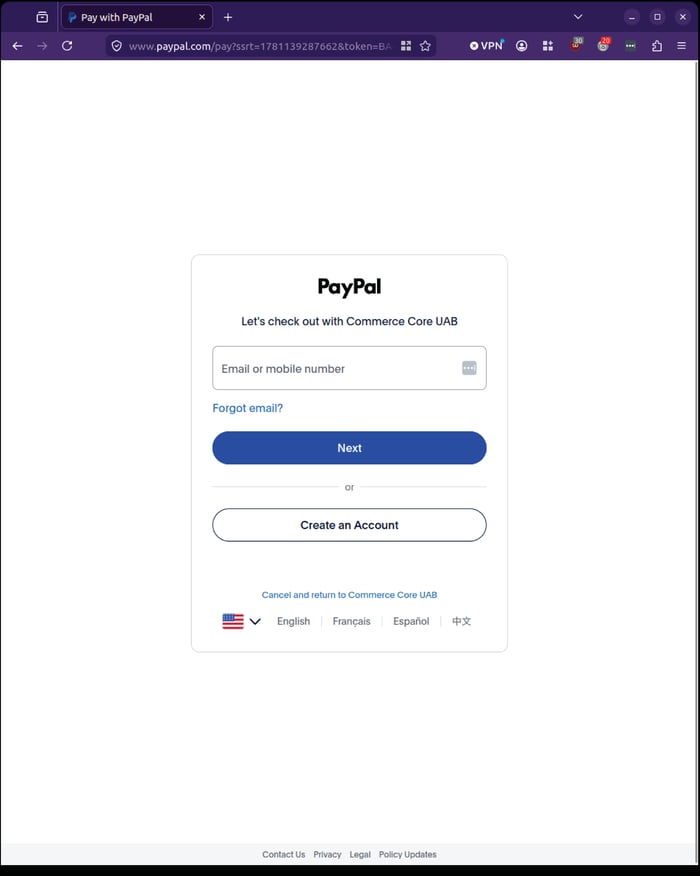
Although the payment process appears to utilise legitimate payment infrastructure, including PayPal, the campaign remains deceptive for several reasons.
First, recipients are enticed through false association with a trusted telecommunications provider.
Second, the campaign uses fabricated scarcity and urgency tactics to influence purchasing decisions.
Third, the promoted product appears substantially similar to low-cost WiFi extender devices widely available through online marketplaces at significantly lower prices.
Most importantly, the entire sales process relies on misleading branding and social engineering techniques designed to gain trust through association with Telstra.
Even when a scam is not directly stealing credentials, deceptive campaigns like this can still result in financial loss, privacy concerns, and exposure to future fraud.
Warning Signs to Watch For
MailGuard recommends looking for the following indicators:
The sender does not match the brand
The email prominently displays Telstra branding, but the sending infrastructure has no obvious connection to Telstra.
Artificial urgency
Claims that offers will expire within hours or that only a limited number of products remain are commonly used to pressure recipients into acting quickly.
Generic customer messaging
The email is not personalised and relies on broad marketing language designed to appeal to a wide audience.
Unrelated websites
Recipients are directed through multiple domains and websites rather than remaining within official Telstra-owned properties.
Too-good-to-be-true discounts
Large discounts tied to surveys, rewards programs, or exclusive loyalty offers should always be independently verified through official channels.
Stay Safe, Know the Signs
MailGuard advises all recipients of these emails to delete them immediately without clicking on any links. Responding or providing personal details can lead to identity theft, data breaches, and financial losses.
Avoid emails that:
- Aren’t addressed to you personally.
- Are unexpected and urge immediate action.
- Contain poor grammar or miss crucial identifying details.
- Direct you to a suspicious URL that isn’t associated with the genuine company.
Many businesses turn to MailGuard after a near miss or incident. Don't wait until it's too late. Reach out to our team for a confidential discussion by emailing expert@mailguard.com.au or calling 1300 30 44 30.
One Email Is All That It Takes
All that it takes to devastate your business is a cleverly worded email message that can steal sensitive user credentials or disrupt your business operations. If scammers can trick one person in your company into clicking on a malicious link or attachment, they can gain access to your data or inflict damage on your business.
For a few dollars per staff member per month, you can protect your business with MailGuard's specialist AI-powered, zero-day email security. Special Ops for when speed matters! Our real-time zero-day, email threat detection amplifies our client’s intelligence, knowledge, security and defence. Talk to a solution consultant at MailGuard today about securing your company's inboxes.
Stay up-to-date with MailGuard's latest blog posts by subscribing to free updates. Subscribe to weekly updates by clicking on the button below.